"The Craft of Research" (3rd ed.) - Wayne Booth et al
Index
Part I: Research, Researchers and Readers
Ch. 1 Thinking in Print: The Use of Research, Public and Private
Part II: Asking Questions, Finding Answers
Ch. 3 From Topics to Questions
Ch. 4 From Question to Problem
Ch. 5 From Problems to Sources
Ch. 6 Engaging secondary sources
Part III: Making a claim and supporting it
Ch. 7 Making Good Arguments: An Overview
Ch. 8 Making Claims
Ch. 9 Assembling reasons and evidence
Ch. 10 Acknowledgments and responses
Ch. 11 Warrants
Part IV: Planning, drafting and revising
Ch. 12 Planning
Ch. 13 Drafting your report
Ch. 14 Revising your organisation and your argument
Ch. 15 Communicating evidence visually
Ch. 16 Introductions and conclusions
Ch. 17 Revising style: Telling your story clearly - on rhetoric
Part V: Some last considerations - the ethics of research
Preface
- Having the ability to answer why it is significant is important. Worse than I don't agree is I don't care.
- 'Warrants' (Stephen Toulmin) are a new concept in research methods
Part I: Research, Researchers and Readers
- Knowledge results from answering questions
You'll also discover how new knowledge depends on what questions you ask—and don't; how the way you present your research shapes the questions you can ask and how you answer them.
- One must find the pleasure inherent in knowledge. I've lost it.
- Research refines research skills further.
- There will be frustration and confusion but one must be confident in the methods refined since the ancients that clarity will result if not at your hands then by the reader and future researchers.
- Research for a reader.
- There are two plans: (i) how to research (ii) how to report
- You are in a conversation with other written works.
[T]hink of your project not as solitary work but as a conversation with sources whose work you read and with those who will in turn read your work
Ch. 1 Thinking in Print: The Use of Research, Public and Private
- We live our lives trusting the research of others to know reality otherwise unknown to us.
- They - Yellows Pages to PhDs - all wrote up their research because they knew that one day someone would have a question that they could answer.
- We write to remember, understand and evaluate; to record, to ensure we can see the meanings expressed clearly, to test its truth, use and value.
- When you write for others, you disentangle ideas from memories and wishes.
- A writer has to envision his reader - 'work with them', not talking down nor sucking up.
- You must think of your reader as someone who doesn't know but needs to.
- There are three reasons that a reader ought to know what you offer:
i. "This new information may interest you." Assume you have an interested audience. You will build one. This is helpful to know to build social media clout audience of buyers and supporters. Enthusiasm is infectious regardless if others find the subject material interesting at first.
ii. "This new information solves your (pratical/'applied') problem."
iii. "This new information solves your (conceptual/'pure') problem." And remember philosphy is the highest pursuit of man. Imagined scenarios or drama/comedy help us explore these pure and applied problems of your community.
- "I'll play my role if you play yours."You cast yourself in one of these three roles and your reader in a 'social contract' with you.
- Three roles of a reader:
i. Entertaining enthusiasts in your subject matter with even hunches and speculations. This is not applicable for a PhD research project.
ii. Solving practical specific need of a non-enthusiast relevant to subject matter e.g. historical information for a filmmaker for scenes. This can be used for a classroom exercise.
iii. Enlightening experts in your subject matter with fresh insights, connections and data. They will interrogate your findings for truth, authencity and value to the field. This is what applies to academic research.
Part II: Asking Questions, Finding Answers
Prologue: Planning your project - an overview
- Data is inert information gathered to process as answers to questions. Once used like that, they become evidence.
- Once you have collected enough data to support at least a plausible answer to your question, you'll be ready to assemble an argument that makes your case, then to plan, draft, and revise it.
- This may not necessarily flow in a linear fashion. You may have a tentative argument before all data collection, or you may end up altering your initial question.
- When you write as you go, every day, you encourage your own best critical thinking, understand your sources better, and, when the time comes, draft more productively.
Quick Tip: Creating a Writing Group
Create a group of four researchers. Summarise project with: I am working on X because I want to find out Y, so that I (and you) can better understand Z. This expands with time and work. Group can then interrogate. Talk also about anticipated responses of reading community to your project.
Ch. 3 From Topics to Questions
- Know your Why - this is made easier by finding a solution to a problem that you can convince a reader to care about.
- Research often begins with small mental itches ("Why do cats rub their faces against us?" rather than Big Questions ("Is behaviour learned or inherited?")
- A question raises a problem if not answering it keeps us from knowing something more important than its answer e.g. If Are there ultimate particles? is unanswered, then the question on the nature of physical existence is unanswerable too. However, to know whether Abraham Lincoln's thumb was bigger than his nose - currently - has no benefit in knowing. Not all questions raise problems.
3.1 From an interest to a topic
- A research topic is an interest stated specifically enough for you to imagine becoming a local expert in it. You just want to know a lot more about it than you do now.
- Start with what most interests you.
3.1.1 Finding a topic in a general writing course
- Look for a blog post that takes a position on a narrow aspect of a larger issue. Investigate why you disagree.
3.1.2 Finding a topic for a first research project in a particular field
- Start with a general encyclopedia than a specialist encyclopedia.
- Skim headings in specialised indexes to see how topic has been even more narrowed.
- Use Google Scholar to find secondary sources.
- Narrow further through journal until more clearly defined.
3.1.3 Finding a topic for an advance project
- Remember you must eventually show why what interests you should also interest others.
- Find what interests past and current researchers through journals, conference progammes and the like.
- Look through recent journal issues for new works and announcements.
- Find libraries with resources that interest you.
3.2 From a broad topic to a focused one
- The risk is to settle on a topic so broad that it has catalogue subheadings e.g. Shakespeare's problem plays.
- A topic too broad can be stated in four to five words e.g. Free will in Tolstoy
- Narrow it: The conflict of free will and inevitability in Tolstoy's description of three battles in War and Peace
- Narrow topics with words and phrases derived from verbs expressing actions or relationships. Your topic lacking them is static.
- Turn them into claims that readers might find interesting: The conflict of free will and inevitability in Tolstoy's description of three battles in War and Peace [topic] -> In War and Peace, Tolstoy describes three battles in which free will and inevitability conflict.
- Thin at first, the claims becomes richer with research.
- Don't narrow too much so you can't find data.
3.3 From a focused topic to questions
- Avoid data dumping concluding with Thus we see many difference and similarities between...
- If there are no specific questions, there are no specific answers.
- Serious researchers do no report data for their own sake, but to support the answer to a question that is worth asking.
- Formulate questions: don't hoover data, harness data.
- Focus on How and Why over Who, What, When and Where.
- To engage critical thinking, interrogate validity of categories, biases, unspoken assumptions, absent voices, locality of logic, your own emotional reactions (excited, defensive, calmed, complacency, etc) and the like.
- Record questions that arise without answering at this stage.
3.3.1 Ask about the history of your topic
- How does topic fit in larger context of its development? Why did it come into being? What came before masks? How were masks invented? Why? What might come after masks?
- What is its own internal history? How have Native American masks changed?
3.3.2 Ask about its Structure and Composition
- How does your topic fit into the context of larger structures and function as part of a larger system? How do masks reflect the values of different societies and cultures?
- How do its parts fit together as a system? What parts of a mask are most significant in Hopi ceremonies? Why?
3.3.3 Ask how your topic is categorised
- How can your topic be grouped into kinds? What are the different kinds of masks? By use? By geography?
- How does your topic compare to and contrast with other like it? How do Native American ceremonial masks differ from those in Japan?
3.3.4 Turn Positive Questions into Negative Ones
- How do Native American masks not differ from those in Africa?
3.3.5 Ask What if? and other speculative questions
- How would things be different if your topic never existed, disappeared, or were put into a new context? What if everyone wore masks in public?
3.3.6 Ask questions suggested by your sources
- This requires some preliminary reading. Ask questions that build on agreement:
- Extend a claim you find persuasive: Masked balls became popular in the eighteenth-century London in response to anxiety about social mobility. Did the same anxieties cause similar developments in Venice?
- Support with new evidence: Smith supports his claim with newspaper sources. Can it be supported with letters and diaries?
- Use parallels sources: Smith analyses costumes from an economic point of view. What would an economic analysis of masks turn up also?
- And then disagreements: Jones claim carnival masks uniquely allow wearers to escape social norms. But could there be a larger pattern of all masks creating a sense of alternative forms of social or spiritual life?
- An experienced researcher answers questions asked but unanswered at the end of other reasearch work and journal articles, or even online discussions
3.3.7 Evaluate your questions
- Evaluate questions once exhausted because not all questions are equally worthwhile to pursue (keep your reader in mind). Best questions are those that make others see the topic in a new way.
- Reject questions whose answers are a Google search: Do Inuits wear masks at weddings? How and why are more interesting than journalist What, Who, Where, When.
- Reject questions whose answers are merely speculative: Would church attendance be better with mask? If you can't find hard data to settle the question, it's a question you can't settle.
- Reject questions whose answers are impossible: How many black cats slept in Alamo the night before the battle?
- However, be aware that seemingly silly questions can lead to profound insights e.g. why coffee spills dry as a circle led to chemistry discoveries
- Once you havce a few promising questions, try to combine them into larger ones: How and why have users of the Alamo story given the event a mythic quality?
3.4 From a question to its significance
- See it like this: what will be lost if you don't answer your question?
- Start by asking so what?
- Just curious is good enough to start, but not to finish.
3.4.1 Step 1: Name your topic
- I am trying to learn (working on, studying) about ______
- Fill in blank with your topic and the action nouns: I am working on Lincoln's beliefs about predestination and their influence on his reasoning...
3.4.2 Step 2: Add an indirect question
- Add an indirect question that indicates what you do not know or understand about your topic:
- I am studying/working on ________
- because I want to find out who/what/when/where/whether/ why/how
- I am studying/working on ________
- I am working on Lincoln's beliefs about predestination and their influence on his reasoning
- because I want to find out how his belief in destiny influenced his understanding of the causes of the Civil War...
- When you add that because clause, you state why you are pursuing your topic: to answer a question important to you.
3.4.3 Step 3: Answer So what? by motivating your question
- This second indirect question helpes my reader understand how, why or whether
- I am working on Lincoln's beliefs about predestination and their influence on his reasoning
- because I want to find out how his belief in destiny influenced his understanding of the causes of the Civil War,
- in order to help my reader understand how his religious beliefs may have influenced his military decisions
- Topic: What are you writing about - I am working on the topic of...
- Question: What you don't know about it - because I want to find out...
- Significance: Why you want your read to know - on order to help my reader understand better...
Ch. 4 From Question to Problem
- You need to create value in exchange for the attention of research community - a deeper understanding of something that matters to them. At that point, you have posed a problem that they recognise needs a solution.
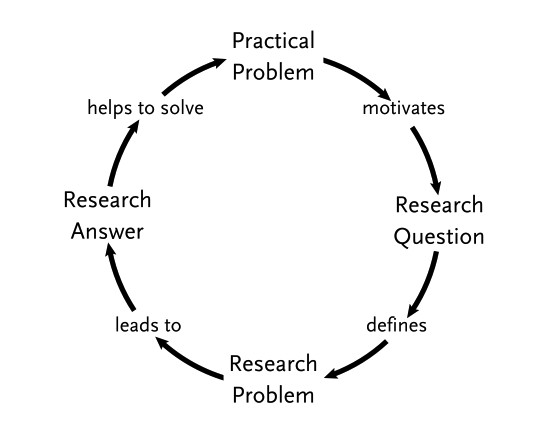
4.1.1 Practical problems: What should we do?
Practical problem: Brakes screech
Research problem: Find repair shop locally on Google
Research solution: Shop address
Practical solution: Go shop and pay to repair
4.1.2 Academic research problems: what should we think?
-
- A conceptual problem arises when we simply do not understand something about the world as well as we would like. We solve them by answering questions that better help us understand.
- In everyday life, we try to avoid a problem, but in academic research, a problem is sought, even invented if required.
4.2 Understanding the common structure of problems
-
- Practical problems and conceptual problems have the same two-part structure:
- a situation of condition
- undesirable consequences caused by that condition, costs that you or your readers want to avoid
- What distinguishes them is the nature of those conditions and costs.
- Practical problems and conceptual problems have the same two-part structure:
4.2.1 The nature of practical problems
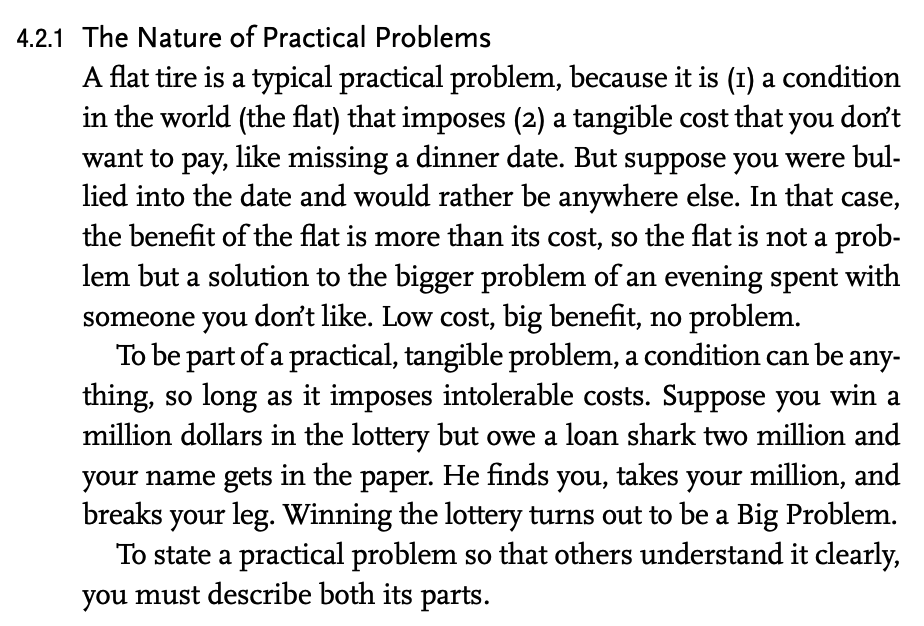
- A practical problem comprises of two parts
- Condition "I missed the bus"
- Costs "I will be late for work and lose job"
- To make your conceptual problem your reader's problem, you must frame it from their point of view, so that they see its cost to them.
- We acknowledge a problem only when we stop asking so what? "Ozone layer hole growing" so what? "More ultraviolet light" so what? "Skin cancer"...
4.2.2 The nature of conceptual problems
- Condition (also: cost) of practical problem: unhappiness; condition (or better: consequence) of conceptual problem: ignorance
- The consequence of a conceptual problem is a second thing we don't understand because we don't understand the first, and the second is more significant and more consequential than first
- I am studying stories of the Alamo, because I want to understand why voters responded to them in ways that served the interests of local Texas politicians, in order to help readers understand the bigger and more important question of how regional self-images infuence national politics.
- The answer to the first question helps you answer the second question, and the answer to the second question is more important than the answer to the first. Your relevant research community does not need to be persuaded beyond a certain point that distinguishes its interests from outsiders.
4.2.3 Distinguishing "Pure" and "Applied" research
- You can tell whether research is pure or applied by looking at the last of the three steps defining your project. Does it refer to knowing or doing?
4.2.4 Connecting a research problem to practical consequences
- To formulate a useful applied research problem, you have to show that the answer to the indirect question in step 2 plausibly helps answer the indirect question in step 3. Ask this question:
- (a) if my readers want to achieve the goal of _____ [state your objective from step 3],
- (b) would they think that they could do it if they found out _____? [state your question from step 2]
- (a) If my readers want to protect themselves from unscrupulous politicians
- (b) would they think they could if they knew how nineteenth-century politicians used stories about the Alamo to shape public opinion? The connection is tentative.
- If you think that the solution to your conceptual problem might apply to a practical one, formulate your problem as the pure research problem it is, then add your application as a fourth step:
- (1) Topic: I am studying how nineteenth-century versions of the Alamo story differ
- (2) Conceptual Question: because I want to find out how politicians used stories of great events to shape public opinion
- (3) Conceptual Significance: in order to help readers understand how politicians use popular culture to advance their political goals,
- (4) Potential Practical Application: so that readers might better protect themselves from unscrupulous politicians.
- When you state your problem in your introduction, however, formulate it as a purely conceptual research problem whose significance is in its conceptual consequences. Then wait until your conclusion to suggest its practical application.
- A big problem is solved by solving smaller connected problem.
4.3 Finding a good research problem
Don't be discouraged if you can't formulate your problem fully at the outset of your project. Few of us can.
Ways to aim for a problem from the start and along the way:
4.3.1 Ask for help
- However, good teachers want you to use their suggestion as a beginning for your own thinking not as an end in itself.
4.3.2 Look for problems as you read
- Look for contradictions, inconsistencies and incomplete explanations in your sources.
- Tentatively assume that othe readers would or should feel the same.
- See 6.4 for our to find problems in a source.
- Look for proposals in conclusion to published research.
4.3.3 Look at your own conclusion
- An unanticipated claim during research may be an answer to a question you had yet asked.
4.4 Learning to work with problems
- The ability to convince someone of the merit of studying medieval Tibetan rugs can convince anyone of anything - the most prized skill!
Quick tip: Manage the unavoidable problem of inexperience
- Uncertainty and anxiety are natural and inevitable. They signal not incompetence but inexperience.
- Write as you go along no matter how sketchy.
- A good question facilitates manageable stages.
- The struggle is the learning experience.
Ch.5 From Problems to Sources
Continue reading on topic until you formulate a research question. Once you have at least one promising answer (hypothesis on probabtion - C. S. Peirce), you can start looking for data to test it.
5.1 Knowing how to use three kinds of sources
5.1.1 Primary sources
5.1.2 Secondary sources
5.1.3 Tertiary sources
5.2 Locating sources through a library
5.2.1 Planning your search
5.2.2 Searching for specific sources if too many, narrow to last fifteen/ ten years. Consider how the topic of 'friendship' was an important philosophical one but neglected recently in encyclopedias.
5.3 Locating sources on the internet
5.4 Evaluating sources for relevance and reliability
5.4.1 Relevance
For books:
-
- Skim index for key words and then skim pages with them
- Skim first and last paragraphs in chapters that use a lot of your key words
- Skim prologues, introductions, summary chapters, and so on
- Skim last chapter, especially first and last couple of pages
- Skim editor's introduction to article collections
- Check bibliography for relevant titles
For articles:
-
- Read abstract
- Skim introduction and conclusion
- Skim section headings and read first and last paragraphs
- Check bibliography for relevant titles
For online sources:
-
- Follow steps for article
- Use Index and Search for key words
5.4.2 Evaluating Sources for Reliability
- Reputable publisher? Hotly contested topics like global warming can be funded by interest groups.
- Peer-reviwed?
- Reputable author?
- Reputable online organisation?
- Shelf life? Journal artciles last ten years for social sciences. Standard editions of primary sources may not necessarily be the newest.
- References for claims and citations?
- Books reviews?
- Citations?
5.5 Following biographical trails
5.6 Looking beyond predicatble sources
5.7 Using people as primary sources
Ch. 6 Engaging secondary sources
- It's human nature to filter data for confimation and ignore the contrary. Resist this.
- Take notes carefully
6.1 Knowing what kind of evidence to look for
6.2 Record complete bibliographical data
6.3 Engaging sources actively
- If you can, read important sources twice. First, what sparks your interest; second, unclear parts.
- First, for understanding; second, slowly and critically.
- If you can't sum up a passage in your mind, you don't understand it well enough to disagree.
- Don't accept a claim upon authority.
- Be wary of duelling experts. Don't confuse mere opinion with valid conclusions.
- Be careful not to misrepresent.
6.4 Using secondary sources to find a problem
- Read sources to find a problem - disagreement, unclear, could be improved etc.
6.4.1 Look for creative agreement
- If you agree to a claim:
- Offer additional support:
"Smith uses anecdotes to show that the Alamo story has mythic statud beyond Texas, but editorials in big-city newspapers offer better evidence."- Source supports a claim with old evidence, but you offer new evidence.
-
Source supports a claim with weak evidence, but you offer stronger evidence.
- Confirm unsupported claims:
"Smith recommends visualisation to improve sports performance, but MRI studies of the mental activities of athletes offer evidence that shows why that is good advice."-
Source speculates ________ might be true, but you offer evidence to show that it is.
-
Source assumes ________ is true, but you can prove it.
-
- Apply a claim more widely:
"Smith argues that medical students learn physiological processes better than when they are explained with many metaphors rather than with just one. The same seems true for engineering and law students."-
Source correctly applies ________ to one situation, but you apply it to new ones.
-
Source claims that ________ is true in a specific situation, but you show it’s true in general.
-
- Offer additional support:
6.4.2 Look for creative disagreement
- To disagree for research problems:
- Contradictions of kind:
"Smith says that certain religious groups are 'cults' because of their strange beliefs, but those beliefs are no different in kind from standard religions"- Source claims that _____ is a kind of ______, but it's not.
- Source claims that _____ always had _____ as one of its features or qualities, but it doesn't.
- Source claims that _____ is normal/good /significant /useful/ moral/ interesting, but it's not.
- Though a source says ____ is not a kind of _____, it is.
- Part-whole contradictions - mistakes how parts of something are related:"
"Smith has argued that sports are crucial to an educated person, but in fact athletics have no place in college."
-
Source claims that __________ is a part of __________, but it’s not.
-
Source claims that one part of __________ relates to another in a certain way, but it doesn’t.
-
Source claims that every __________ has __________ as one of its parts, but it doesn’t.
-
-
Developmental or historical contradictions - a source mistakes the origin or development of a topic:
"Smith argues that the world population will rise, but it won’t."-
Source claims that __________ is changing, but it’s not.
-
Source claims that __________ originated in __________, but it didn’t.
-
Source claims that __________ develops in a certain way, but it doesn’t.
-
-
External cause- effect contradictions - a source mistakes a causal relationship:
"Smith claims that juveniles can be stopped from becoming criminals by “boot camps.” But evidence shows that they don’t."- Source claims that __________ causes __________, but it doesn’t / they are both caused by __________.
-
Source claims that __________ is sufcient to cause __________, but it’s not.
-
Source claims that __________ causes only __________, but it also causes __________.
-
Contradictions of perspective - most contradictions don’t change a conceptual framework, but when you contradict a “standard” view of things, you urge others to think in a new way:
"Smith assumes that advertising has only an economic function, but it also serves as a laboratory for new art forms."-
Source discusses __________ from the point of view of __________, but a new context or point of view reveals a new truth [the new or old context can be social, political, philosophical, historical, economic, ethical, gender specific, etc.].
-
Source analyzes __________ using theory / value system __________, but you can analyze it from a new point of view and see it in a new way.
-
- Contradictions of kind:
6.5 Using secondary sources to plan your argument
6.5.1 Reading secondary sources for data to use as evidence
- Check original sources for data cited.
- You don't need to use data for the argument in the secondary source.
- The more at stake, the higher the threshold of reliability, and that means more data.
- Look for examples of arguments that failed because of insufficient or unrepresentative evidence. To learn what works, you must know what doesn't.
6.5.2 Reading Secondary Sources for Claims to Use as Support
- To use such claims as evidence, you have to report not only the conclusion of the source but its reasoning and supporting evidence as well.
6.5.3 Reading Secondary Sources for Models of Argument and Analysis
- You do not plagiarize a source when you borrow its logic. Don’t worry that your argument will be unoriginal. The logic of a research argument is rarely original. Readers will look for originality in your problem, claim, and evidence.
"As Weiman (1998) shows about the Arthurian legends, those responsible for the Alamo legend also gained the most from its depiction of Texas as an outpost civilization..."
6.5.4 Reading Secondary Sources to Define Your Problem
- Experienced researchers usually present their problem in relation to the research that led them to it. Before they state their problem in their introduction, they describe the line of research that their work will replace, correct, refine, or extend. So as you read secondary sources, look for research questions similar to yours. You can use those earlier studies in your introduction to define a gap that your work will fill.
"Historians have been interested in ways that communities use legends to create and maintain political and social identity. For early Christian communities, it was the Grail legend (Gromke 1988); for England, it was the Arthurian legend (Weiman 1998); for . . . For the new Republic of Texas, it was the legend of the Alamo."
6.5.5 Reading Secondary Sources for Arguments to Respond To
- No research report is complete until it acknowledges and responds to its readers’ predictable questions and disagreements. You can find some of those competing views in secondary sources.
6.6 Recording what you find
6.6.1 Take full notes
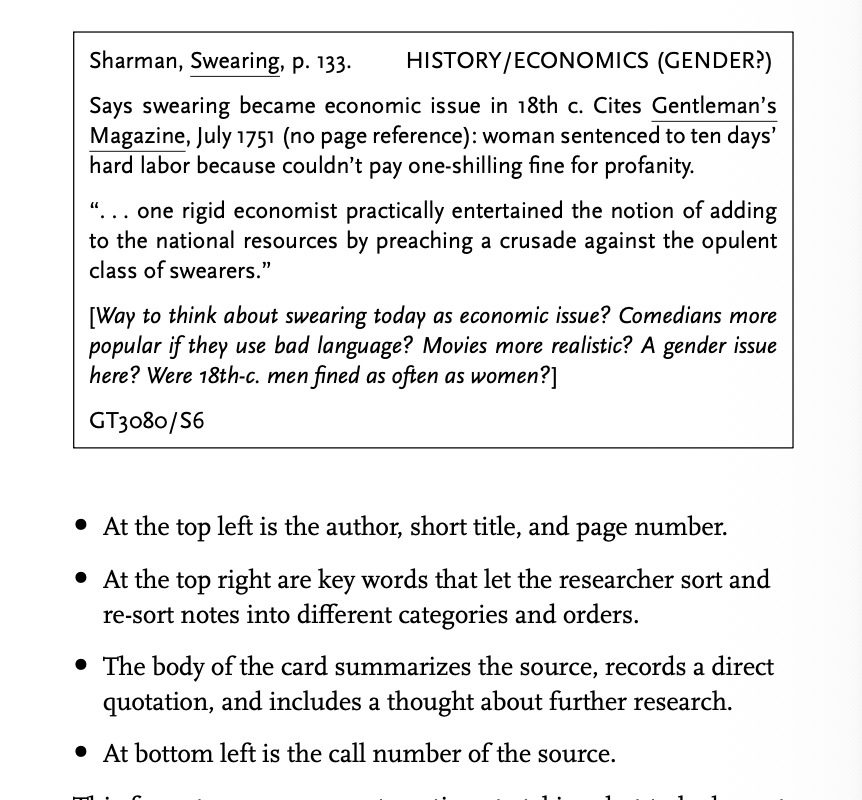
6.6.2 Know When to Quote, Paraphrase, and Summarize
- In general, researchers in the humanities quote most often; social and natural scientists usually paraphrase and summarize.
-
Summarize when you need only the point of a passage, section, or even whole article or book. Summary is useful for context or views that are related but not specifically relevant. A summary of a source never serves as good evidence.
-
Paraphrase when you can represent what a source says more clearly or pointedly than it does. Paraphrase doesn’t mean changing just a word or two. You must replace most of the words and phrasing of the original with your own. A paraphrase is never as good evidence as a direct quotation.
- Record exact quotations for these purposes:
- The quoted words are evidence that backs up your reasons. If, for example, you claimed that diferent regions responded to the Battle of the Alamo diferently, you would quote exact words from diferent newspapers. You would paraphrase them if you needed only their general sentiments.
- The words are from an authority who backs up your view.
- The words are strikingly original or express your ideas so compellingly that the quotation can frame the rest of your discussion.
- They state a view that you disagree with, and to be fair you want to state that view exactly.
6.6.3 Record in conext
As you use material from your sources, record not just what they say but how they use the information.
- When you quote, paraphrase, or summarize, be careful about context:
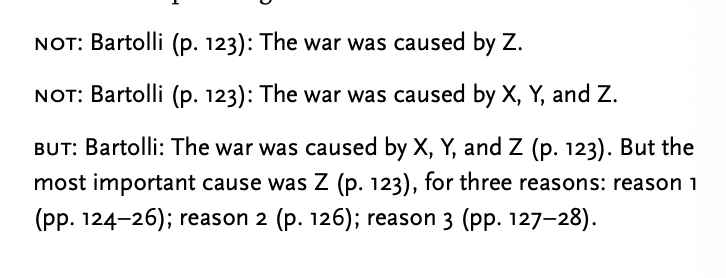
Sometimes you will care only about the conclusion, but readers usually want to see how a conclusion emerges from the argument supporting it. So when you take notes, record not only conclusions but also the arguments that support them.
2. When you record a claim, note its rhetorical importance in the original.
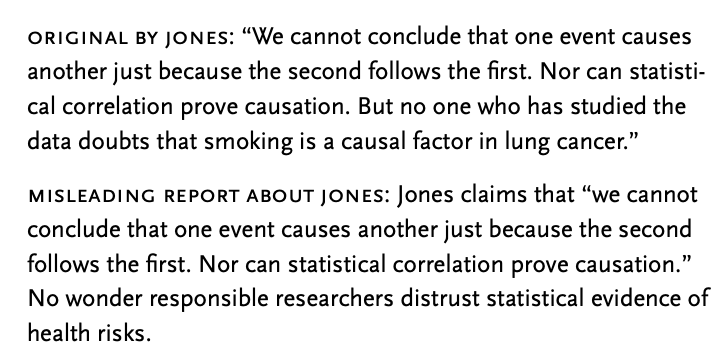
Distinguish statements that are central to an argument from qualifications or concessions the author acknowledges but down plays. Unless you are reading “against the grain” of the writer’s intention—to expose hidden tendencies, for example—do not report minor aspects of a research report as though they were major or, worse, as if they were the whole of the report.
3. Record the scope and confi dence of a claim.
Chemicals in french fries cause cancer ≠ Some chemicals in french fries correlate with a higher incidence of some cancers.
4. Don’t mistake a summary of another writer’s views for those of an author summarizing them.
5. Note why sources agree and disagree.
- How and why sources agree is as important as the fact that they do.
- Person 1 says social problem is caused by personal factor not environmental factor. Person 2 says the same. Person 1 says the personal factor is family. Person 2 says the personal factor is friends.
-
If you rely on at least two sources, you’ll almost always find that they do not agree entirely, and that’s where your own research can begin. Which has the better argument? Which better respects the evidence? In fact, you have a research problem right there—whom should we believe?
The irrelevant also has value.
Good thinking is a skill that you can learn, but you can exercise it only when you have a deep and wide base of facts, data, and knowledge to work on. So read sources not just to answer the question you ask today, but to help you think better about every question you'll ask for the rest of your research career. To that end, everything you read is relevant.
Quick Tip: How to overcome anxiety of muddle
You can minimize the panic by taking every opportunity to organize and summarize what you have gathered by writing as you go and by returning to the central questions: What question am I asking? What problem am I posing? Keep rehearsing that formula: I am working on X to learn more about Y, so that my readers can better understand Z. You can also turn to friends, classmates, teachers—anyone who will serve as a sympathetic but critical audience. Explain
how what you have learned bears on your question and helps you resolve your problem. Ask them: Does this make sense? Am I missing anything important? What else would you like to know? You will profit from their reactions, but even more from the mere act of explaining your ideas to nonspecialists.
Part III: Making a claim and supporting it
Prologue: Assembling a research argument
- As the data amasses, you need a more powerful principle of organization, one based not on your data but on the solution to your problem and the logic of its support. That support takes the form of a research argument.
- It is a cooperative conversation to find the truth about matter of common importance.
- Opinions require no defence.
- In a research argument, we are expected to make claims not just because we believe they’re true but because we think they are new and important enough to change what readers think. Then we support those claims with sound reasons and good evidence, as if our readers were asking us, quite reasonably: Why should I believe that?
- Of course, when you write an argument, no one is there to ask you those questions in person. So you must imagine them on your readers’ behalf. It’s those imagined questions and your answers that make your argument seem to be, if not an actual conversation, then at least in the spirit of one.
- First, assemble your argument to see if it persuades you; then revise it into a report that you think will persuade your reader.
Ch. 7 Making Good Arguments: An Overview
- Only after you sort your data into the elements of an argument that answers your readers’ predictable questions can you see what research you still have to do. When you plan your argument early, you grasp your material better and avoid wasted effort, especially return trips to the library.
7.1 Argument as a conversation with readers
- In a research report, you make a claim, back it with reasons, support them with evidence, acknowledge and respond to other views, and sometimes explain your principles of reasoning.
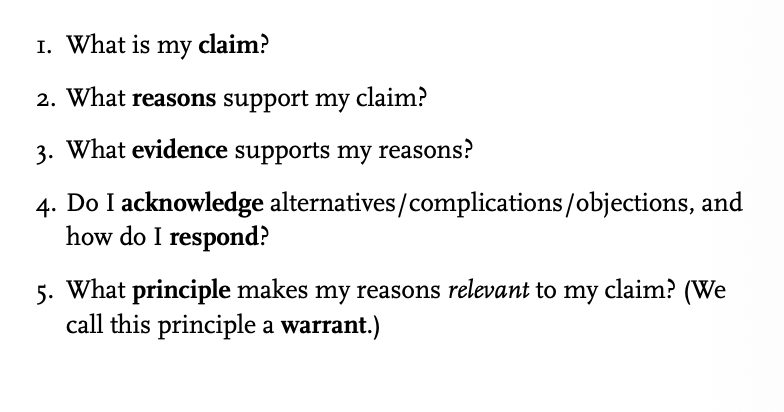
7.2 Supporting your claim
- A claim is supported by two pillars: (1) reasons, and (2) evidence.
CLAIM because of REASON based on EVIDENCE
7.2.1 Base claims on reason
- A complex claim usually requires multiple reasons and sub-reasons. A reason is a statement supporting a claim, main or not.
7.2.2 Base reasons on evidence
- Reason is an act of the mind. Evidence is tangible. A writer/speaker must share evidence first with a reader/listener to convince their reason for the claim.
- To offer a complete argument, however, you must add at least one more element and often a second: you must acknowledge other points of view and offer what we call warrants, which show how a reason is relevant to a claim.
7.3 Acknowledging and responding to anticipated questions and answers
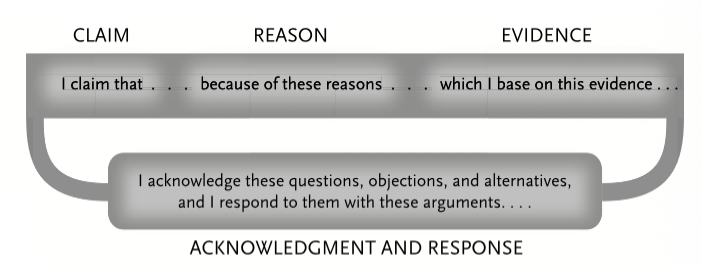
7.4 Warranting the relevance of your reasons To support the relevance of a reason, you must offer a general principle that justifies relating your particular reason to your particular claim.


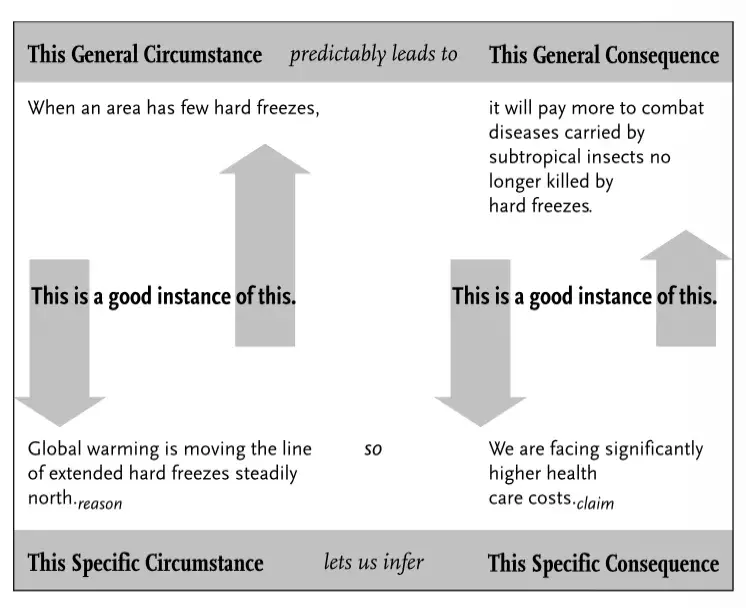
The logic behind all warrants is that if a generalization is true, then so must be specific instances of it. But for that logic to work, readers must agree with four things.
(1) The warrant is true: fewer hard freezes in fact mean higher medical costs.
(2) The reason is true: hard freezes in fact are moving north.
(3) The specific circumstance in the reason qualifies as a plausible instance of the general circumstance in the warrant.
(4) The specific consequence in the claim qualifies as a plausible instance of the general consequence in the warrant.
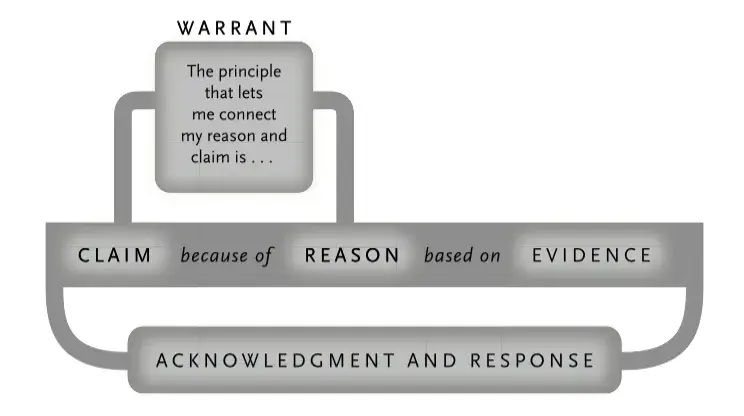
7.5 Building a complex argument out of simple ones
- If your readers doubt the truth of a warrant, you may have to treat it as a subclaim and support it with its own argument, including reasons, evidence, and perhaps even its own warrant with its own acknowledgments and responses.
- Only the evidence “stands alone,” but even then you must explain where you got it and maybe why you think it’s reliable, and that may require yet another argument.
- Most arguments include background, definitions, explanations of issues that readers might not understand, and so on. If, for example, you were making an argument about the relationship between inflation and money supply to readers not familiar with economic theory, you would have to explain how economists define “money.”
7.6. Creating an ethos by thickening your argument
- Readers judge your arguments not just by the facts you offer, but by how well you anticipate their questions and concerns. In so doing, they also judge the quality of your mind, even your implied character, traditionally called your ethos.
- When you acknowledge other views and explain your principles of reasoning in warrants, you give readers good reason to work with you in developing and testing new ideas. In the long run, the ethos you project in individual arguments hardens into your reputation, something every researcher must care about, because your reputation is the tacit sixth element in every argument you write. It answers the unspoken question, Can I trust you? That answer must be Yes.
Quick tip: A common mistake—Falling back on what you know
Each field has its own distinctive way to make an argument. However, within a field, there can be competing methodologies, objectives, values and so on.
Seek out alternative methods, formulate not only multiple solutions but multiple ways of supporting them, ask whether others would approach your problem differently.
Ch. 8 Making Claims
- You must also be sure that your claim is not just sound, but significant enough to need an argument in the first place.
(1) What kind of claim should I make?
(2) Is it specific enough?
(3) Will readers think it is significant enough to need an argument supporting it?
- When you can answer those three questions, you’re ready to assemble your argument.
8.1 Determining the kind of claim you should make
- The kind of problem you pose determines the kind of claim you make and the kind of argument you need to support it.
- Academic solutions asks readers not to act but to understand.
- If you want readers to act, be explicit about what action you want them to take:
Businesses that invest in IT systems benefit only when they know how to use them to improve productivity -> Before investing in IT systems, a business should restructure its organization and management to use the system productively. - If you want to suggest a practical application of your conceptual claim, do it in your conclusion. There you can offer it as an action worth considering without having to develop a case for it.
8.2. Evaluating your claim
- How to find a good claim can't be taught but to evaluate a reader's judgment on one requires it to specific and significant.
8.2.1 Make your claim specific
- Vague claims lead to vague arguments. You make a claim more specific through specific language and logic.
(1) Specific language
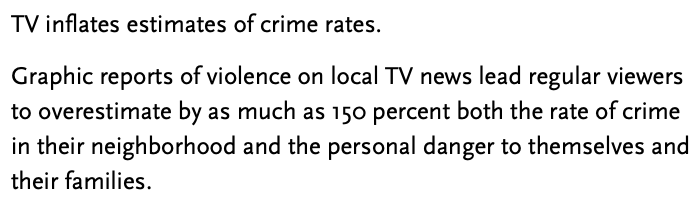
- You benefit when you include in early drafts of your claim more terms than you might ultimately use.
(2) Specific logic
- As you draft your working claim, try elaborating its logic in two ways:
- Introduce it with a qualifying clause beginning with although or even though.
- Conclude it with a reason clause beginning with because.
Regular TV viewers overestimate both the rate of crime in their neighborhood and the personal danger to themselves and their families.
->
Although violent crime is actually decreasing, regular TV viewers overestimate their neighborhood crime rate by 150 percent and therefore misjudge personal danger to themselves and their families, because local TV evening news regularly opens with
graphic reports of mayhem and murder in familiar locations, making many believe that crime happens nightly outside their front door.
- Three of the five elements that you need in a full argument:
(1) Although I acknowledge X, (2) I claim Y, (3) because of reason Z. - You can use an introductory although clause to acknowledge three kinds of alternative views:
- something that your readers believe but your claim challenge:
- Although most people believe they are good judges of their security, regular TV viewers overestimate . . .
- a point of view that conflicts with yours:
-
Although many security professionals see fear as the best motivation for safety precautions, regular TV viewers overestimate . . .
-
-
a condition that limits the scope or confidence of your claim:
-
Although it is dificult to gauge their real feelings about personal security, regular TV viewers overestimate . . .
-
- something that your readers believe but your claim challenge:
8.2.2. Make your claim significant
- If readers accept a claim, how many other beliefs must they change?
- You can gauge the significance of your claim by asking how strongly readers might contest it. One way to do that is by considering the contestability of its opposite claim.
Hamlet is not a superficial character.
Hamlet is a superficial character.
This report summarizes recent research on the disappearance of bees.
This report does not summarize recent research on the disappearance of bees.
- If the reverse of a claim seems obviously false (like the first one) or trivial (like the second), then readers are likely to think the original claim is not worth an argument.
Quick tip: Qualifying claims to enhance your credibility
- Acknowledge limiting conditions
Limit your claims to what your argument can actually support by qualifying their scope and certainty. This gains readers' trust.
Unless it can be shown that the newspapers critical of Roosevelt were controlled by special interests [limitation on claim], their attacks demonstrate significant popular dissatisfaction with Roosevelt’s presidency [restatement of claim].
Use hedges to limit certiainty. If you hedge too much, you will seem timid or uncertain. It takes a deft touch.
Ch. 9 Assembling reasons and evidence
- If a reader doesn’t believe the evidence, they’ll reject the reasons, and with them the claim.
9.1 Using reasons to plan your argument
- To start a storyboard of your argument, write your main claim and each reason (and subreason) at the top of separate cards or pages. Then below each reason (or subreason), list the evidence that supports it. If you don’t have it yet, note the kind of evidence you’ll need. Finally arrange the pages on a table or wall to make their logical relationships visible at a glance. Shuffle reasons to test logic.
9.2 Distinguishing evidence from reasons
- A write up reports evidence not present it itself.
- First, data you take from a source have invariably been shaped by that source, not to misrepresent them, but to put them in a form that serves that source’s ends.
- Second, when you in turn report that data as your own evidence, you cannot avoid manipulating them once again, at least by putting them in a new context.
- In short, facts are shaped by those who collect them and again by the intentions of those who use them.
- You have to assure your readers that they can trust your data. The last link in that chain of credibility is you, so be thoughtful about whose data you use and how you use them.
- When you observe the standard procedures in your field, you encourage readers to accept your evidence at your word, without their needing to see it themselves. So as you read secondary sources, note the kind of evidence they cite, how they cite it, then do likewise. When in history, do as historians do.
9.4 Evaluating your evidence
- Evidence must be:
(1) accurate
(2) appropriate
(3) representative
9.4.1 Report evidence accurately
- Careful readers are predisposed to be skeptical. Getting the easy things right shows respect for your readers and is the best training for dealing with the hard things. You can sometimes use even questionable evidence, if you acknowledge its dubious quality. In fact, if you point to evidence that seems to support your claim but then reject it as unreliable, you show yourself to be cautious, self-critical, and thus trustworthy.
9.4.1 Be appropiately precise
The Forest Service has spent a great deal of money to prevent forest fires, but there is still a high probability of large, costly ones.
- How much though?
- Evidence can also be too precise. Only a foolhardy historian would assert that the Soviet Union reached its point of inevitable collapse at 2:13 p.m. on August 18, 1987.
9.4.3 Provide sufficient, representative evidence
- Not just one figure, though sometimes only one bit of evidence is suficient to disprove a claim.
Ch. 10 Acknowledgments and responses
- How to anticipate two sources of critique:
(1) Instrinsic soundness - the clarity of your claim, the relevance of your reasons, the quality of your evidence.
(2) Extrinsic soundness - considering alternatives: different ways of framing the problem, evidence you’ve overlooked, what others have written on your topic.
- When you imagine, acknowledge, and respond to both kinds of questions, you create an argument that readers are more likely to trust.
10.1 Questioning instrinsic soundness (defensive)
- Turn to responses once core argument assembled.
- Assume mindset of opposition.
- First, question your problem:
(1) Why do you think there’s a problem at all? What are the costs or consequences in this situation?
(2) Why have you defined the problem as you have? Is it conceptual or pragmatic? Maybe the problem involves not the issue you raise but another one.
- Second, question your solution:
(3) What kind of solution do you propose? Does it ask me to do something or to understand something? Does it match the problem exactly? Are they both practical or both conceptual?
(4) Have you stated your claim too strongly? I can think of exceptions and limitations.
(5)(a) Why is your conceptual answer better than others? It contradicts our well-established knowledge.
(5)(b) Why is your practical solution better than others? It will cost too much, take too much time, or create new problems.
- If you imagine a question that you can’t answer, decide whether you can find the answer before you go on. Don’t go easy on yourself with this one: the time to fix a problem with your argument is when you find it.
- If weak but answerable, acknowledge in draft thesis.
- Third, question your support:
1. I want to see a different kind of evidence—hard numbers, not anecdotes. (Or—stories about real people, not cold numbers.)
2. Your evidence isn’t accurate. The numbers don’t add up.
3. It isn’t precise enough. What do you mean by “many”?
4. It isn’t current. There’s newer research than this.
5. It isn’t representative. You didn’t get data on all the groups.
6. It isn’t authoritative. Smith is no expert on this matter.
7. You need more evidence. One data point (quotation, number, anecdote) is not proof.
10.2 Questioning exstrinsic soundness (offensive)
- As you read, you will find examples of how others have thought about your secondary and primary sources.
- Look for difference approaches and focuses on problem.
- Don’t dismiss evidence because you think it is irrelevant or unreliable. If your readers might consider it relevant, acknowledge it but explain why you didn’t use it. That’s one way to compensate for not having enough evidence of your own.
10.3 Deciding what to acknowledge
- Strike balance.
10.3.1 Selecting objections to respond to
- Look for alternatives that let you repeat a part of your argument. For example, if readers might think of exceptions to a definition that in fact are not, acknowledge them and use the response to reinforce your point:
Some have argued that even food can be addictive, but remember we are concerned here only with substances for which addiction is the norm, not those . . .
10.3.2 Acknowledging questions you can't answer
- If you discover a flaw that you cannot fix or explain away, try to redefine your problem or rebuild your argument to avoid it.
- But if you cannot, it can be used against you. Acknowledge the problem and respond that:
-
- the rest of your argument more than balances the flaw
- while the flaw is serious, more research will show a way
-
while the flaw makes it impossible to accept your claim fully, your argument offers important insight into the question and suggests what a better answer would need around it
- Occasionally researchers turn failure into success by turning the claim they wanted to support but couldn’t into a hypothesis that people might think is reasonable but turns out not to be. Then they show why not:
It might seem that when jurors hear the facts of a case in a form that focuses on the victim and emphasizes her suffering, they will be more likely to blame the accused. That is, after all, the standard practice of plaintiffs’ lawyers. But in fact, we found no correlation
between . . .
10.4 Framing your responses as subordinate arguments
- You must respond to your acknowledged objections and alternatives.
- Minimal if obvious:
Some have argued that food can be addictive, [acknowledgment of alternative claim] but we are concerned here only with substances for which addiction is the norm [reason why alternative is irrelevant]
- Otherwise:
Some have argued that food can be addictive, [acknowledgment of alternative claim] but we are concerned here only with substances for which addiction is the norm. [reason why alternative is irrelevant] Some who taste chocolate once may be unable to resist it thereafter, but their number is a fraction of those who are immediately addicted to crack cocaine after a single exposure. [subreason] Chernowitz (1998) found that just
one exposure resulted . . .[report of evidence]
- A substantial response may require an argument, in which case it has to be placed in the storyboard as a reason/evidence.
10.5 The vocabulary of acknowledgement and response
10.5.1 Acknowledging objections and alternatives
- When you respond to an alternative or objection with terms like although, some may argue etc, you can mention and dismiss it or address it at length.
10.5.2 Responding to objections and alternatives
- But, however, or on the other hand.
1. There are causes in addition to the one you claim. If your argument is about cause and effect, remember that no effect has a single cause and no cause has a single effect. If you argue that X causes Y, every reader will think of other causes e.g. collapse of Soviet Union is due to Reganite military buildup.
So if you focus on one cause out of many, acknowledge the others. And if you feel readers might think that some cause deserves more attention than you give it, acknowledge that view and explain why you deemphasized it.
2. What about these counterexamples? No matter how rich your evidence, readers are likely to think of exceptions and counter-examples that they think undermine your argument. So you must think of them first, then acknowledge the more plausible ones, especially if they are vivid. Then explain why you don’t consider them as damaging as your reader might. Be particularly wary when you make claims about a phenomenon with a wide range of variation, such as the climate. Readers who do not understand statistical reasoning will focus on an aberrant case, even though it falls within a normal distribution: a cold Fourth of July in Florida does not disprove a claim about global warming, any more than a warm New England Christmas proves it.
3. I don’t define X as you do. To me, X means...To accept your claim, readers must accept your definitions, because definitions are crucial warrants.
When your argument turns on the meaning of a term, define it to support your solution, then make an argument supporting your definition. Be aware of plausible alternative definitions that you may need to acknowledge. If you use a technical term that also
has a common meaning that your readers use (like social class or theory), acknowledge the ordinary definition and explain why you use the technical one to solve your problem. If you do not use a technical definition as expert readers expect you to, acknowledge that and explain why you use the common meaning.
Ch. 11 Warrants
- A warrant is a statement that connects a reason to a claim.
11.1 Warrants in everyday reasoning
I hear the FBI has been questioning the mayor’s staff. [reason] He must be involved in something crooked. [claim]
Warrant: There is no smoke without fire
- The logic behind that reasoning is this: if the general proverb/ warrant is true (the sign of something implies its existence), then specific instances of that situation must also be true.
- This general circumstance predictably implies this general consequece.
- This specifc circumstance lets us infer this specific consequence.
11.2 Warrants in academic arguments
- Academic warrants aren’t commonplaces that we all share; they are specific principles ofreasoning that particular communities of researchers develop over centuries of thinking and writing, and they are countless.
- Advanced researchers rarely state warrants in their reports, because they assume that their readers know them, and so stating them would seem condescending.
- For example, biologists argue that:
a whale is more closely related to a hippopotamus than to a cow, [claim] because it shares more DNA with a hippopotamus. [reason]
- If, however, a nonbiologist asked that question, a biologist would offer a warrant that othe biologists take for granted:
When a species shares more DNA with one species than it does with another, [condition] we infer that it is more closely related to the first. [consequence]
- There is another reason academic warrants are harder to grasp than proverbs: they are usually phrased less explicitly. Most proverbs have two distinct parts, a circumstance and its consequence: Where there’s smoke, there’s fire.
- But we can also compress those two parts into one short statement—Smoke means fire—something that we rarely do with proverbs but that specialists often do with their warrants. For example, a biologist might compress the warrant about species:
Shared DNA is the measure of the relationship between species.
- In other words, some warrants don’t explicitly distinguish a circumstance from its predictable consequence. But however compressed a warrant might be, we can always deconstruct it into its two parts. For purposes of clarity, we’ll state warrants in their most explicit two- part form: When X, then Y.
11.3 Understanding the logic of warrants
- The warrant would consist of two parts, (1) a general circumstance that lets us draw a conclusion about (2) a general consequence.
- But both the circumstance and consequence have to be more general than the specific reason and claim.
11.4 Testing whether a warrant is reliable
1. Is that warrant basically true?
2. Is it prudently limited?
3. Is it trumped by a competing warrant?
4. Is it appropriate to this field of research?
5. Are the specific reason and claim good instances of the general warrant?
11.4.1 Is that warrant basically true?
- When you think readers might question the truth of your warrant, you must treat it as a claim in its own argument, supported by its own reasons and evidence.
11.4.2 Is it prudently limited?
- A warrant can be true but within limits. They have to be qualified.
In the eighteenth and early nineteenth centuries, valuable objects were listed in wills.
In the eighteenth and early nineteenth centuries, most household objects considered valuable by their owners were usually listed in wills.
11.4.3 Is it trumped by a competing warrant?
- Some warrants seem to contradict each other: Out of sight, out of mind and Absence makes the heart grow fonder.
11.4.5 Are the specific reason and claim good instances of the general warrant?
Few doubt that when we expose children to examples of admirable behavior, we influence them for the better. How can we then deny that when they are constantly exposed to images of sadistic violence, they are influenced for the worse? [warrant ] Violence among children 12–16 is rising faster than among any other age group. [reason] Brown (1997) has shown that...[evidence] We can no longer ignore the conclusion that TV violence is a destructive influence on our children today. [claim]
- The specific circumstance, rising violence, is not a valid instance of children being exposed to images of sadistic violence. So even if the reason is true, it’s irrelevant to the claim.
- To fix that argument, we have to revise the reason to be a good instance of the warrant:
Few doubt that when children are exposed to examples of admirable behavior, they are influenced for the better. How then can we deny that when they are constantly exposed to images of sadistic violence, that exposure influences them for the worse? [warrant] All our data show that violence among children 12–16 is rising faster than among any other age group. This violence results from many factors, but we can no longer ignore the conclusion that because television is the major source of children’s images of violence, [reason] it is a destructive influence on our children. [claim]
- But a reader keen to derail the argument might still object:
Wait. All those images aren’t “sadistic.” Much of it is cartoon violence. And children aren’t exposed to it.
- Careful readers regularly challenge reasons because they are not grounded on sound evidence, but no less often because they seem irrelevant to a claim. To answer the first objection, you must find better evidence. To answer the second, you must construct a warrant that makes your reasons relevant. If you can’t, you must revise your argument.
11.5 Knowing when to state a warrant
- Most principles of reasoning are tacit, but there are three occasions when you should state them:
(1) Your readers are outside your field.
(2) You use a principle of reasoning that is new or controversial in your field.
(3) You make a claim that readers will resist because they just don’t want it to be true.
When children manifest behavior arising not from teaching or modeling but spontaneously, such behavior is probably genetically based.[warrant] [Reasons and evidence follow.] We must therefore consider whether homosexuality has a genetic component,claim because many of its characteristics appear in the feelings of preteens who become homosexual adults, even though they have had no contact with homosexuals. [reason]
- When readers think that both a warrant and reason are true, and that the specific reason and claim are good examples of the warrant, they are logically obliged at least to consider the claim. If they don’t, no rational argument is likely to change their minds.
11.6 Challenging others' warrants
- When you challenge one of their warrants, first imagine how they would defend it.
- Since warrants can be based on different kinds of supporting arguments e.g. moral, religious, you have to challenge them in different ways.
11.6.1 Challenging warrants based on experience
- To challenge those warrants, you have two choices, both diffcult:
(1) challenge the reliability of the experience;
(2) find counter-examples that cannot be dismissed as special cases.
- With second, you can then argue for exceptions without directly contradicting the experience or reasoning of your readers.
11.6.2 Challenging warrants based on authority
- The easiest—and friendliest—way is to argue that, on the matter in question, the authority does not have all the evidence or reaches beyond its expertise.
11.6.3 Challenging warrants based on systems of knowledge
- These warrants are backed by systems of definitions, principles, or theories. e.g. from biology: When an organism reproduces, its individual offspring differ.
- When you challenge these warrants, “facts” are largely irrelevant. You must either challenge the system, always diffcult, or show that the case does not fall under the warrant.
11.6.4 Challenging general cultural warrants
- "Commonsense" aphroisms. Warrants like these may change over time, but slowly. You can challenge them, but readers will resist, because you seem to challenge their heritage.
11.6.5 Challenging methodological warrants
- Think of these as “meta- warrants,” general patterns of thought with no content until applied to specific cases. We use them to explain abstract reasoning (they are the source of many proverbs):
Generalization: When every known case of X has quality Y, then all X’s probably have quality Y. (See one, see them all.)
Analogy: When X is like Y in most respects, then X will be like Y in other respects. (Like father, like son.)
Sign: When Y regularly occurs before, during, or after X, Y is a sign of X. (Cold hands, warm heart.)
- We challenge only their application or point out limiting conditions: Yes, we can analogize X to Y, but not if . . .
11.6.6 Challenging warrants based on articles of faith
- Such warrants are backed not by the evidence of our senses but by the certainty of those who espouse them. It is pointless to challenge them. If you encounter them as you gather your data, ignore them or treat them not as a subject for research but as an inquiry into the meaning of life.
Quick tip: Two kinds of arguments
There are fundamentally two kinds of arguments:
(1) One kind of argument backs up a claim with reasons based on evidence.
(2) The other infers a claim from a reason and warrant.
The former is preferred over the latter.
All arguments ultimately rely on warrants. But readers of research reports tend to distrust a claim that’s based only on an unqualified and unlimited warrant, because such arguments are usually more ideological than factual. Researchers want to see claims based on sound reasons based on hard evidence, not derived from articles of faith. If it helps, add a warrant to nail down your claim, but always back up your reasons with good evidence.
Needle- exchange programs contribute to increased drug use, [claim] because when addicts think they can avoid the risk of disease, they feel it is safe to use more drugs.reason A study of those who participated in one such program reported that 34 percent of the participants increased their use of drugs from 1.7 to 2.1 times a week because they reported feeling protected from needle- transmitted diseases. [evidence]
Needle- exchange programs contribute to increased drug use, [claim] because when addicts think that they can avoid the risk of disease, they feel it is safe to use more drugs. [reason] Whenever the costs of risky behavior are reduced, people engage in it more often. [warrant]
Part IV: Planning, drafting and revising
Prologue: Planning again
You’re ready to plan a draft when you know the following:
- You know who your readers are, what they know, anwhy they should care about your problem.
- You know the kind of ethos or character you want to project.
- You can sketch your question and its answer in two or three sentences.
- You can sketch the reasons and evidence supporting your claim.
- You know the questions, alternatives, and objections that your readers are likely to raise, and you can respond to them.
Quick tip: Outlining (topic-based v. point-based) and storyboarding
Topic-based outlining: nouns and phrases:
I. Introduction: Laptops in Classrooms
II. Uses
A. Labs
B. Classroom
III. Revision Studies
A. Study A
B. Study B
IV. Conclusion
I. Introduction: Value of classroom computers uncertain.
II. Different uses have different effects.
A. All uses increase flexibility.
B. Networked computer labs allow student interaction.
C. Classroom computers rarely enhance learning.
D. In- class laptops often a distraction (Facebook, e-mail, surfing).
III. Studies show benefits to revision are limited.
A. Study A: writers more wordy.
B. Study B: writers need hard copy to revise effectively.
IV. Conclusion: Too soon to tell how much classroom laptops improve learning.
A. Too few reliable empirical studies.
B. Too little history, too many programs in transition.
C. Some schools adding programs; some dropping programs.
- Storyboarding is discombulating floating protean points that can be assembled in the process of research and writing.
Ch. 12 Planning
12.1 Three wrong plans
-
- Do not give a narrative of your thinking. Articulate an argument.
- Do not data dump or summarise sources. Give analysis, create new value.
- Do not repeat question rubric. Design conceptual framework for response.
12.2 Planning your report
12.2.1 Sketch a working introduction
(1) Expect to write your introduction twice, a working one for yourself, then later a final one for readers. Summarize only the sources that you intend to correct, modify, or expand on. Then order in way useful to readers: chronologically, by quality, significance, point of view, and so on.
(2) After summary of sources, rephrase question as statement about a flaw or gap that you see in them.
Why is the Alamo story so important in our national mythology?
→ Few of these historians, however, have explained why the Alamo story has become so important in our national mythology.
(3) Sketch answer to So what if we don’t find out? even if speculative.
If we understood how such stories become national legends, we would better understand our national values, perhaps even what makes us distinct.
(4) State the answer to your question as your point, or promise an answer in a launching point.
- You have two choices here:
- State the point of your paper at the end of your introduction to frame what follows and again near the beginning of your conclusion.
- State it only in your conclusion, as a climax to your reasoning.
- This is a crucial choice, because it creates your social contract with your readers.
- If you state our main point toward the end of your introduction, you put your readers in charge: Reader, you control how to read this report. You know my problem and its solution, my point. You can decide how—even whether—to read on. No surprises.
- On the other hand, if you wait until your conclusion to state your main claim, you create a more controlling relationship: Reader, you must follow me though every twist and turn until we reach the end, where I will finally reveal my point.
- Most readers prefer to see your main point at the end of your introduction, because that lets them read what follows faster, understand its relevance better, and remember it all longer. Stating your claim early also helps keep you on track.
12.2.2 Identify key concepts that will run through your whole report
- If you find few key terms, your topic and point may be too general.
12.2.3 Plan the body of your report
(1) Sketch background, define terms, contextualise, set limits.
(2) Create page for each reason to support claim
(3) Edit suitable order. This can be done in two ways: part-by-part (i.e. by subtopic: relationship function, hieraching placing) or chronological (i.e. earlier to later; cause and effect).
- These next six are based on your readers’ knowledge and understanding:
(1) Short to long, simple to complex. Most readers prefer to deal with simple issues
before they work through more complex ones.
(2) More familiar to less familiar. Most readers prefer to read about more familiar issues before they read about new ones.
(3) Less contestable to more contestable. Most readers move more easily from what they agree with to what they don’t.
(4) More important to less important (or vice versa). Readers prefer to read more important reasons first (but those reasons may have more impact if they come last).
(5) Earlier understanding to prepare for later understanding. Readers may have to understand some events, principles, definitions, and so on before they understand something else.
(6) General analysis followed by specific applications. Readers may have to understand the outlines of your overall position before they can follow how you apply it to specific texts, events, situations, and so on.
- Often, these principles cooperate: what readers agree with and easily understand might also be short and familiar. But these principles may also conflict: readers might reject most quickly reasons that are most important. Whatever your order, it must reflect your readers’ needs, not the order that the material seems to impose on itself (as in an obvious compare- contrast organization).
- Make working ordering with tags of first, second etc...; more importantly...; a more complex issue is...; as a result...
12.2.4 Plan each section and subsection
(1) Just as your whole report needs an introduction, so does each of its sections.
(2) Indicate where to put evidence, acknowledgments, warrants, and summaries. They may, in turn, need to be supported by their own arguments.
12.2.5 Draft a working conclusion
- State your point again at the top of a conclusion page of your storyboard. After it, if you can, sketch its significance (another answer to So what?).
Ch. 13 Drafting your report
13.1 Draft in a way that feels comfortable
- Quick drafting requires slow revising. Slow drafting requires detailed planning.
13.2 Use key words to keep yourself on track
13.3 Quote, paraphrase, summarise appropriately
- Summarize when details are irrelevant or a source isn’t important enough to warrant much space.
- Paraphrase when you can state what a source says more clearly or concisely or when your argument depends on the details in a source but not on its specific words.
-
Quote for these purposes:
— The words themselves are evidence that backs up your reasons.
— The words are from an authority who backs up your claims.
— The words are strikingly original or express your key concepts so compellingly that the quotation can frame an extended discussion.
— A passage states a view that you disagree with, and to be fair you want to state it exactly.
13.4 Integrating direct quotations into your text
- If four lines or fewer, use run-in text with quote marks. Five or more, use indented blocks.
13.5 Show readers how evidence is relevant
- Evidence never speaks for itself, especially not long quotations or complex sets of numbers.
- You must speak for such evidence by introducing it with a sentence stating what you want your readers to get out of it.
13.6 Guard against inadvertent plagiarism
13.6.1 Cite the source of every quotation, paraphrase, or summary
- Be especially careful to cite a paraphrase or summary as you draft it; otherwise, you may not even remember that it originated with a source.
13.6.2 Signal every quotation, even when you cite its source
- Once you cite striking words, you can use them again without quotation marks or citation.
- Since it’s better to seem naive than dishonest, especially early in your career, use quotation marks freely.
13.6.3. Don't paraphrase too closely
- You paraphrase appropriately when you represent an idea in your own words more clearly or pointedly than the source does. But readers will think that you plagiarize if they can match your words and phrasing with those of your source.
Plagiarism:
Booth, Colomb, and Williams claim that appropriate paraphrase uses one’s own words to represent an idea to make a passage clearer or more pointed. Readers can accuse a student of plagiarism, however, if his paraphrase is so similar to its source that someone can match words and phrases in the sentence and those in that source.
Border plagiarism:
Appropriate paraphrasing rewrites a passage into one’s own words to make it clearer or more pointed. Readers think plagiarism occurs when a source is paraphrased so closely that they see parallels between their words and phrases. (Booth, Colomb, and Williams 2008)
Not plagiarism:
According to Booth, Colomb, and Williams (2008), paraphrase is the use of your own words to represent the ideas of another more clearly. It becomes plagiarism when readers see a word- for- word similarity between a paraphrase and a source.
- To avoid seeming to plagiarize, read the passage, look away, think about it for a moment; then still looking away, paraphrase it in your own words. Then check whether you can run your finger along your sentence and find synonyms for the same ideas in the same order in your source. If you can, try again.
13.6.4 Cite a source ideas not your own
- Cite a source for an idea when (1) the idea is associated with a specific person and (2) it’s new enough not to be part of a field’s common knowledge.
13.6.5 Don't plead ignorance, misunderstanding, or innocent intentions
- Use quote marks or block quote with citations if the original authors would recognise their own ideas and words unless part of common knowledge now.
13.7 The social importance of citing sources
13.7.1 Citations benefit you
- Citations protect you from a charge of plagiarism, but beyond that narrow self- interest, correct citations contribute to your ethos.
13.7.2 Citations help your readers
13.7.3 Citations honour your sources
- Acknowledge your intellectual debts and enrich the community of minds, passed and unborn.
13.8 Four common citation styles
- For academic research, there are two basic patterns, each with two common versions.
13.8.1 Two basic patterns: Author-Title and Author-Date
- First is more common in humanities; the second for sciences.
13.8.2 Two Author-Title styles
(1) Chicago (or: Turabian)
(2) MLA ("Moden Language Association")
13.8.3 Two Author-Date styles
(1) Chicago
(2) APA ("American Psychological Association")
Ch. 14 Revising your organisation and your argument
- You only improve your ideas when you imagine drawing readers into an amiable conversation in which they engage your beliefs as you engage theirs.
14.1 Thinking like a reader
- Readers begin with a sense of the whole, its structure, and, most important, why they should read your report in the first place.
- They use that sense of the whole and its aims to interpret its parts.
- It makes sense to start revising your overall organization, then its parts, then the clarity of your sentences, and, last, matters of spelling and punctuation.
- When you have a draft and systematically revise top-down, from global structure to words, you are more likely to read as your readers will than if you start at the bottom, with words and sentences, and work up.
14.2 Revising the frame of your report
- Main point in conclusion should be more specific and contestable than one in introduction.
14.3 Revising your argument
- Once drafted, your argument may look different from the way it did in your storyboard or outline.
14.3.1 Identify the substance of your argument
- The structure of the report should map to the structure of your argument. Each section represents a reason.
- Each section should at least a third of evidence: too little and perhaps your reason is unsubstantiated; too much, it may be a data dump.
14.3.2 Evaluate the quality of your argument
- What might cause your readers to reject your argument?
(1) Evidential sufficiency, reliability, and relevance for claim? Be sure you haven’t skipped intermediate subreasons between a major reason and its supporting evidence.
(2) Appropriately qualified: it seems; most likely..?
(3) Conversational or contestal?
(4) Unexpressed warrants?
14.4 Revising the organisation of your report
- Once you are confident in the outer frame of your report and the substance of its argument, make sure that readers will find the whole report coherent.
(1) Ensure keys terms run throughout report.
(2) Signpost and annouce systematically throughout.
(3) Relate new sections to ones that preceded.
(4) Ensure sections relates to whole by substantiating claim either as reason or evidence.
(5) Introduce each section with its point.
(6) Each section needs its own key terms to unify and uniquely distinguish it from the others.
14.5 Check your paragraphs
- Avoid very long paragraphs (for most fields, more than a page) or long strings of short ones (fewer than five lines).
- Use two or three sentence paragraphs only for lists, transitions, introductions and conclusions to sections, or for statements that you want to emphasize.
14.6 Let your draft cool, then paraphrase it
- When you return to it, don’t read straight through; skim its top-level parts: its introduction, the first paragraph of each major section, and its conclusion. Then based only on what you’ve read, paraphrase it for someone who hasn’t read it.
- Even better, ask someone else to skim your report and summarize it: how well that test reader summarizes your argument will predict how well your final readers will understand it. Finally, always revise in light of a teacher’s or adviser’s advice.
Quick tips: Abstracts
In many fields, reports begin with an abstract, a paragraph that tells readers what they will find in the report. It should be shorter than an introduction but do three things that an introduction does:
(1) state the research problem;
(2) announce key themes;
(3) state the main point or a launching point that anticipates the main point.
Three types of abstracts:
(1) Context + Problem + Main Point
(2) Context + Problem + Launching Point
(3) Summary
Ch. 15 Communicating evidence visually
[refer to original]
Ch. 16 Introductions and conclusions
- Once you think you have a draft that works, you’re ready to write your final introduction and conclusion beyond snappy and cute. What seizes attention is a problem that needs a solution, and is of concern:
- contextualizing background with common grounds
- statement of the problem
- response to the problem
16.1 Common structure of introductions
- contextualizing background
- statement of the problem
- response to the problem
16.2 Step 1: Establish common ground
- When you draft your introduction, imagine you are writing to someone who has the same sources as you, but has not achieved your insight.
16.3 Step 2: State your problem
- Once you establish common ground, disrupt it with a problem. As we’ve said, the statement of a research problem has two parts:
(1) a condition of incomplete knowledge or understanding, and
(2) the consequences of that condition, a more significant gap in understanding
16.3.1 When should you state the condition of a problem explicitly
- In the humanities and some social sciences, researchers more often pose questions that they alone have found or even invented, questions that readers find new and often surprising.
- In that case, you must explicitly describe the gap in knowledge or flawed understanding that you intend to resolve.
16.3.1 Stating consequences of gaps and benefits of findings
- To convince readers that they should take your problem seriously, you must state the cost they will pay if it is not resolved or the bene fits they gain if it is.
- In pure research, the consequence is misunderstanding and the benefit is better understanding.
16.3.3 Testing conditions and consequences
- Convince of significance.
16.4 Step 3: State your response
- Once you disrupt your readers’ stable context with a problem, they expect you to resolve it with your main point. You can state that point in one of two ways.
(1) State the gist of your solution
(2) Promise a solution
16.5 Setting the right pace for the introduction
- A full introduction consists of just three elements: Context + Problem + Response
- You don’t need all three in every report:
- If the problem is well known, omit the common ground.
- If the consequences of the problem are well known, omit them.
- If you want readers to follow your thinking before they know your answer, offer a launching point at the end of your introduction and state your main point in your conclusion.
- All this may seem formulaic, but it’s what readers expect. And when you master a rhetorical pattern like this, you have more than a formula for writing. You also have a tool for thinking. By forcing yourself to work through a full statement of your common ground and problem, you have to think hard about what your readers know, what they don’t, and, in particular, what they should know and why.
16.6 Writing your conclusion
- A conclusion is written using the same elements in an introduction, in reverse order.
16.6.1 Start with your main point
- State your main point near the beginning of your conclusion.
- If you already stated it in your introduction, repeat it here but more fully; do not simply repeat it word-for-word.
16.2.2 Add a new significance or application
- After your point, say why it’s significant, preferably with a new answer to So what?
16.3.3 Call for more research
- State what remains to do. It keeps the conversation alive.
16.7 Impactful openings
(1) Relevant fact
(2) Quotation, only if its words anticipate key terms in the rest of your introduction
(3) Relevant anecdote, only if its language anticipates your topic and vividly illustrates your problem.
16.8 Memorable endings
- You can bring your report to a graceful, even literary close with an echo of your opening fact, anecdote, or quotation.
Quick tip: Titles
Put key words from main point in title
Ch. 17 Revising style: Telling your story clearly - on rhetoric
- To ensure that your sentences will be as clear to your readers as they are to you, you need a way to identify difficult sentences even when they seem fine to you.
17.1 Judging style
- There’s nothing wrong with using impressionistic words to describe your feelings, but they don’t help you fix unclear sentences, because they don’t explain what it is on the page that makes you feel as you do.
- For that, you need a way to think about sentences that connects an impression like confusing to what it is in the sentence, on the page that confuses you.
17.2 The first two principles of clear writing
- These principles focus on only two parts of a sentence: the first six or seven words and the last four or five.
- Get those words straight, and the rest of the sentence will (usually) take care of itself.
- To use these principles, though, you must understand five grammatical terms: simple subject, whole subject, verb, noun, and clause.
(1) On subjects and characters
- Readers will judge your sentences to be clear and readable to the degree that you make their subjects name the main characters in your story.
- When you do this, your subjects will be short, specific, and concrete.
If rain forests are stripped to serve short-term economic interests, the earth’s biosphere may be damaged
[better than]
The stripping of rain forests in the service of short-term economic interests could result in damage to the earth’s biosphere.
(2) Verbs, nouns and actions
- In sentences that are clear, their subjects are characters and their actions are expressed not as nouns but as verbs.
- When you express actions not with verbs but with abstract nouns, you also clutter a sentence with articles and prepositions.
Now that we [subject] have standardized [verb] an index to measure thought disorders, we [subject] can quantify [verb] how patients [subject] respond [verb] to different treatments.
[better than]
Our standardization of an index for the measurement of thought disorders [subject] has made [verb] possible the quantification of response as a function of treatment differences.
- The last sentence adds one a, as, and for; two thes, and four ofs, all because four verbs were turned into nouns: standardize → standardization, measure → measurement, quantify → quantification, respond → response.
- There is a technical term for turning a verb (or adjective) into a noun: we nominalize it. (This term defines itself: when we nominalize the verb nominalize, we create the nominalization: nominalization.)
- Most nominalizations end with sufixes such as -tion, -ness, -ment, -ence, -ity. But some are spelled like the verb: change ➞ change; delay ➞ delay; report ➞ report.
- When you turn adjectives and verbs into nouns, you can tangle up your sentences in two more ways:
- A. You have to add verbs that are less specific than the verbs you could have used. In unclear sentence, instead of the specific verbs standardize, measure, quantify, and respond, we have the single vague verb made.
- B. You are likely to make the characters in your story modifiers of nouns or objects of prepositions or to drop them from a sentence altogether: in the unclear sentence, the character we becomes our, and thereafter the rest of the characters are missing in action.
- Express crucial actions in verbs.
- Make your central characters the subjects of those verbs; keep those subjects short, conccrete, and specific.
- Look for nouns ending in - tion, - ment, - ence, and so on. If they are the subjects of verbs, turn them into verbs.
(3) Diagnosis and revision
- To diagnose:
i. Underline the first six or seven words of every clause, whether main or subordinate.
ii. Perform two tests:
a. Are the underlined subjects concrete characters, not abstractions?
b. Do the underlined verbs name specific actions, not general ones like have, make, do, be, and so on?
- To revise:
iii. If the sentence fails either test, you should probably revise.
a. Find the characters you want to tell a story about. If you can’t, invent them.
b. Find what those characters are doing. If their actions are in nouns, change them into verbs.
c. Create clauses with your main characters as subjects and their actions as verbs.
- You will probably have to recast your sentence in some version of If X, then Y; X, because Y; Although X, Y; When X, then Y; and so on.
(4) On being a character
- A character is anything we can make the subject of a lot of verbs in a sequence of sentences, including abstract terms such as monetary policy.
- Some abstract nominalizations are the nomenclature in certain reading communities.
- In general, though, readers prefer sentences whose subjects are short, specifc, and concrete. And that usually means flesh-and-blood characters.
(5) Avoiding excessive abstraction
- Don’t change every abstract noun into a verb.
- If your best central character is an abstraction, avoid others you don’t need.
(6) Creating main characters
- Turn passive into active for clarity if required.
17.3 Third principle: Old before new
(a) Because the naming power of words was distrusted by Locke, he repeated himself often. Seventeenth-century theories of language, especially Wilkins’s scheme for a universal language involving the creation of countless symbols for countless meanings, had centered on this naming power. A new era in the study of language that focused on the ambiguous relationship between sense and reference begins with Locke’s distrust.
(b) Locke often repeated himself because he distrusted the naming power of words. This naming power had been central to seventeenth-century theories of language, especially Wilkins’s scheme for a universal language involving the creation of countless symbols for countless meanings. Locke’s distrust begins a new era in the study of language, one that focused on the ambiguous relationship between sense and reference.
- In the disjointed (a) version, the sentences after the first one begin with information that a reader could not predict. In contrast, the sentences after the first one in (b) begin with information that readers would find familiar.
- In (a) each sentence begins unpredictably, so we can’t easily see the “topic” of the whole passage. In (b) each sentence after the first opens with words referring to ideas that readers recall from the previous sentence.
- Readers follow a story most easily if they can begin each sentence with a character or idea that is familiar to them, either because it was already mentioned or because it comes from the context. From this principle of reading, we can infer principles of diagnosis and revision:
- To diagnose:
i. Underline the first six or seven words of every sentence.
ii. Have you underlined words that your readers will find familiar and easy to understand (usually words used before)?
iii. If not, revise.
- To revise:
i. Make the first six or seven words refer to familiar information, usually something you have mentioned before (typically your main characters).
ii. Put at the ends of sentences information that your readers will find unpredictable or complex and therefore harder to understand.
- This old-new principle happily cooperates with the ones about characters and subjects, because older information usually names a character (after you introduce it, usually at the end of a prior sentence).
- But should you ever have to choose between beginning a sentence with a character or with old information, always choose the principle of old before new.
17.4 Choosing between active and passive
- Rather than worry about active and passive, ask a simpler question: Do your sentences begin with familiar information, preferably a main character? If you put familiar characters in your subjects, you will use the active and passive properly.
(a) The quality of our air and even the climate of the world depend on healthy rain forests in Asia, Africa, and South America. But the increasing demand for more land for agricultural use and for wood products for construction worldwide now threatens these forests with destruction.
(b) The quality of our air and even the climate of the world depend on healthy rain forests in Asia, Africa, and South America. But these rain forests are now threatened with destruction by the increasing demand for more land for agricultural use and for wood products used in construction worldwide.
- The passive allowed us to move the older, more familiar information from the end of its sentence to its beginning, where it belongs. And that’s the main function of the passive: to build sentences that begin with older information. If we don’t use the passive when we should, our sentences won’t flow as well as they could.
- Just avoiding I or we doesn’t make writing more “objective.” It simply changes the story. In fact, the issue of the passive is still more complicated.
- Scientists typically use the first person and active verbs at the beginning of journal articles, where they describe how they discovered their problem and at the end where they describe how they solved it. In between, when they describe processes that anyone can perform, they regularly use the passive.
17.5 Final principle: complexity last
The newest, most complex information goes last. This principle is particularly important in three contexts:
i. when you introduce a new technical term
ii. when you present a unit of information that is long and complex
iii. when you introduce a concept that you intend to develop in what follows
17.5.1 Introducing a new technical term
(a) An understanding of the role of calcium blockers in the control of cardiac irregularity depends on understanding of the calcium activation of muscle groups. The regulatory proteins actin, myosin, tropomyosin, and troponin affect the action of muscle fibers in the sarcomere, the basic unit of muscle contraction.
(b) Muscles contract when their cells are activated by calcium. When heart muscles contract irregularly, we can control them with drugs called calcium blockers. Calcium blockers limit the action of muscle fibers in the basic unit of muscle contraction, known as the sarcomere. It consists of four proteins that regulate contraction: they are actin, myosin, tropomyosin, and troponin.
17.5.2 Introducing complex information
(a) The quality of our air and even the climate of the world depend on healthy rain forests in Asia, Africa, and South America. But the increasing demand for more land for agricultural use and for wood products for construction worldwide now threatens these forests with destruction.
(b) The quality of our air and even the climate of the world depend on healthy rain forests in Asia, Africa, and South America. But these rain forests are now threatened with destruction by the increasing demand for more land for agricultural use and for wood products used in construction worldwide.
- In (a) the second sentence begins with a long, complex unit of information, a subject that runs on for more than a line. In contrast, the subject of the second sentence in (b), these rain forests, is short, simple, and easy to read, again because the passive verb (are now threatened) lets us flip the short and familiar information to the beginning and the long and complex part to the end.
- In short, don’t begin your sentences with complexity; save it for the end. Unfortunately that’s not easy to do, because you may be so familiar with your ideas that you can’t distinguish what is for your readers old and simple from what’s new and complex.
17.5.3 Following what follows
- When you start a paragraph, put at the end of its first or second sentence the key terms that appear in the rest of the paragraph.
- Once you’ve checked the first six or seven words in every sentence, check the last five or six as well. If those words are not the most important, complex, or weighty, revise so that they are.
- Look especially at the ends of sentences that introduce paragraphs or even sections.
Quick tip: the quickest revision strategy
Your first job is to draft something to revise. If you don’t have time to look at every sentence, start with passages where you found it hard to explain your ideas.
Part V: Some last considerations - the ethics of research
- We start with two broad conceptions of the word ethics: the forging of bonds that create a community and the moral choices we face when we act in that community.
- The term ethical comes from the Greek ethos, meaning either a community’s shared customs or an individual’s character, good or bad.
- So far, we have focused on the community-building aspects of research, the bonds we create with our readers and our sources. But as does any social activity, research challenges us to define our individual ethical principles and then to make choices that honor or violate them.
- Thou shalt nots:
- Ethical researchers do not plagiarize or claim credit for the results of others.
- They do not misreport sources, invent data, or fake results.
- They do not submit data whose accuracy they don’t trust, unless they say so.
- They do not conceal objections that they cannot rebut.
- They do not caricature or distort opposing views.
- They do not destroy data or conceal sources important for those who follow.
- Thou shall dos:
- When you create, however briefly, a community of shared understanding and interest, you set a standard for your work higher than any you could set for yourself alone.
- When you explain to others why your research should change their understanding and beliefs, you must examine not only your own understanding and interests, but your responsibility to them if you convince them to change theirs.
- When you acknowledge your readers’ alternative views, including their strongest objections and reservations, you move closer not just to more reliable knowledge, better understanding, and sounder beliefs, but to honoring the dignity and human needs of your readers.